

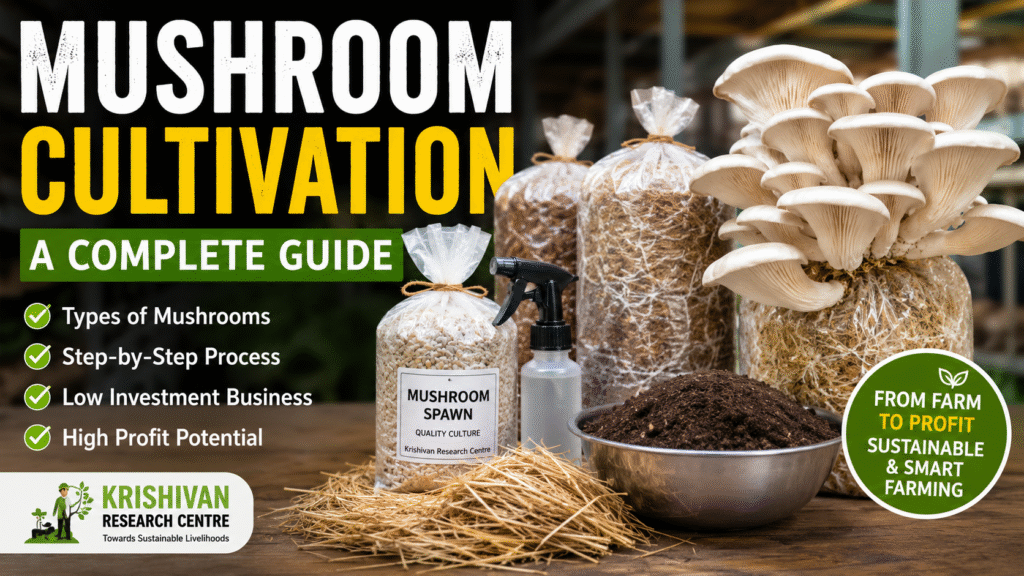
Mushroom Cultivation in India: A Complete Guide to Growing Mushrooms for Beginners
Mushroom Cultivation in India: A Complete Guide to Growing Mushrooms for Beginners Mushroom cultivation is becoming an increasingly promising agricultural activity in India. Unlike conventional crops, mushrooms do not require large areas of cultivable land, and several varieties can be grown using agricultural residues such as paddy straw, wheat straw and other organic materials. With the right growing conditions, quality spawn and proper hygiene, mushroom cultivation can be started on a relatively small scale and gradually developed into a commercial enterprise. For farmers, rural youth, women self-help groups and aspiring agripreneurs, mushroom farming offers an opportunity to convert locally available agricultural resources into a valuable food product. Oyster mushroom cultivation, in particular, is considered comparatively simple and can be adopted after appropriate practical training. At Krishivan Research Centre, mushroom cultivation is approached not only as a farming technique but also as a potential livelihood and enterprise opportunity. Our mushroom training focuses on practical understanding—from spawn and substrate preparation to cultivation, harvesting, packaging and basic enterprise planning. What Is Mushroom Cultivation? Mushroom cultivation is the controlled production of edible fungi under suitable environmental conditions. Instead of depending on naturally occurring mushrooms, growers provide the required substrate, moisture, temperature, humidity, ventilation and other conditions that allow the mushroom mycelium to grow and eventually produce fruiting bodies. Mushrooms are different from green plants because they do not depend on sunlight for photosynthesis. They obtain nutrients from organic material on which they grow. This characteristic makes it possible to cultivate many mushroom varieties indoors or in specially prepared growing rooms. In India, commercially cultivated mushrooms include button mushroom, oyster mushroom, paddy straw mushroom and milky mushroom, among others. The choice of mushroom depends largely on the local climate, availability of substrate, infrastructure, technical knowledge and market demand. Why Is Mushroom Farming Becoming Popular in India? One of the biggest advantages of mushroom cultivation is that it can make productive use of materials that might otherwise be treated as agricultural waste. Paddy straw, wheat straw and several other plant residues can serve as substrates for suitable mushroom species. Research and field demonstrations have shown that oyster mushrooms can be cultivated on a range of agricultural residues, making the practice particularly relevant to small and marginal farming systems. Mushroom cultivation also requires comparatively little land. A properly managed production unit can therefore be established even where conventional agricultural land is limited. Beyond cultivation itself, mushroom farming creates opportunities in areas such as: This makes mushroom cultivation interesting not only for farmers but also for young people looking to develop agriculture-based businesses. Types of Mushrooms Commonly Cultivated in India Different mushroom species require different environmental conditions and cultivation methods. Choosing the right variety is therefore one of the first decisions a new grower needs to make. 1. Oyster Mushroom Oyster mushroom, belonging mainly to the genus Pleurotus, is one of the most accessible options for beginners. It can be cultivated on substrates such as paddy straw and wheat straw after appropriate preparation. Compared with some other commercial mushrooms, oyster mushroom cultivation requires relatively simple infrastructure and can be adapted to different agro-climatic conditions. Research from agricultural institutions has also demonstrated the suitability of different Pleurotus species for cultivation in Uttarakhand, using locally available plant residues as substrates. For beginners, oyster mushroom is often a practical starting point because the cultivation process is comparatively straightforward and the infrastructure requirement can be modest. 2. Button Mushroom The white button mushroom, Agaricus bisporus, is one of the most widely cultivated commercial mushrooms. Button mushroom cultivation involves several important stages, including compost preparation, spawning, casing and crop management. It generally requires more precise environmental management than oyster mushroom cultivation, particularly during cropping. Because temperature management is important, commercial button mushroom production may require greater infrastructure and investment, especially when year-round production is planned. 3. Paddy Straw Mushroom Paddy straw mushroom, Volvariella volvacea, is particularly associated with warm and humid growing conditions. As the name suggests, paddy straw can be used as a major cultivation material. Agricultural research sources indicate that suitable growing conditions include relatively high temperatures and humidity, making this mushroom more appropriate for warmer regions. 4. Milky Mushroom Milky mushroom, Calocybe indica, is another commercially cultivated mushroom in India and is known for its suitability to warmer conditions. Its cultivation can provide an alternative for growers whose local climate is less suitable for cold-loving mushroom varieties. However, growers should select varieties according to local conditions and obtain technical guidance before beginning commercial production. How Does Mushroom Cultivation Work? Although the exact procedure varies according to the mushroom species, commercial mushroom production generally follows a sequence of carefully controlled steps. Step 1: Select the Mushroom Variety The first step is choosing a mushroom suitable for your local climate, available infrastructure and target market. For someone starting on a small scale, oyster mushroom may be a practical choice. Growers interested in commercial button mushroom production need to consider the additional infrastructure and environmental control requirements. The market should also be considered before production begins. Growing a mushroom is only one part of the business; selling it at the right time and maintaining product quality are equally important. Step 2: Arrange Quality Spawn Spawn is the planting material used to introduce mushroom mycelium into the prepared substrate. The quality of spawn has a major influence on successful cultivation. Poor-quality, contaminated or improperly stored spawn can result in slow colonization, contamination and reduced production. For this reason, growers should obtain spawn from reliable sources and follow recommended storage and handling practices. Step 3: Prepare the Substrate The substrate acts as the growing medium for the mushroom. Depending on the species, materials such as paddy straw, wheat straw or other suitable agricultural residues may be used. The substrate needs to be prepared properly before spawning. Preparation may involve chopping, soaking, pasteurization or sterilization, depending on the cultivation system and mushroom variety. The objective is to create a clean and suitable environment in which the mushroom mycelium can colonize the substrate while reducing the